Friday, June 3, 2016


Natural Landscape
In the natural world, my definition of beauty is being able to experience everything in it's natural surrounding. When a bird doesn't see you, but you see it, and it goes about it's business and you get to see it in it's natural environment. When you hear the birds chirping and fresh water running- and are surrounded by the smell of fresh leaves. When the sun just barely peaks through the trees and shines right on you, this to me is beauty. The photo below exemplifies this for me. It reminds me of the creek behind my house, where I feel at peace every time I go to it. It is exactly what I described above, fairly untouched and unexplored by the unnatural world. Everytime I go, I am brought to a place of indescribable peace and contentment, as I look up and see only green.

http://www.gettyimages.ca/detail/video/beech-trees-covering-forest-creek-dolly-shot-stock-footage/499698345
Urban Landscape & Street Photography
3 urban landscape/street photographers:
1) Luca Campigotto is a contemporary photographer. Born in Venice in 1962, he has been photographing landscapes since the 1980’s. His work has shown all over the world and he has nine books published of his work.
http://www.lucacampigotto.com
http://www.lucacampigotto.com
2) Jonathan Fernandez is an interactive designer that explores HDR urban landscape photography. HDR is High Dynamic Range Imaging when a camera takes a picture at several exposure levels rather than just one.
http://www.behance.net/gallery/Urban-Landscape-Photography/17654463) Chris Schoenbohm is a young photographer who is currently traveling the world taking photos. His blog was started last year of his explorations and photography.
http://www.lostmanproject.com/
Additional images:
http://www.lostmanproject.com/
Historical:
 Alfred Steiglitz - 1898
 Alfred Steiglitz - 1915
 Luca Campigotto - 1990s
Contemporary:
Thursday, March 10, 2016
Visual Metaphor
Visual Metaphor

Photo by Jake Hicks
- “I am a rocker chic. All eyes are on me and I look great. Make sure to know where your light is and to reflect it off yourself in flattering ways. Chin up or else you’ll get chins and you know that would not make your manager happy. This is the last shoot you have to stay in the agency; you have to do this well. Pucker your lips, but not too much. Don’t let them see how nervous you are.”
- “I am a leather jacket. I am used to tell people something about someone. Without me, this girl would just be pretty. I add depth to people. I give people confidence and strength. I am being worn for the perception I give, not for who I truly am. But hey, at least I make people look good for a living. These lights are so harsh but they reflect off of me so nicely.”
- “I am similar to the girl in the portrait because I am a brown haired young woman. I am similar because this girl and I most likely both have problems in life and people have expectations of us. We also probably both have good times and bad times in life, and loved ones that we care about and care about us. These things link us, but we also most likely live in different cities, with different interests, and know different people. I am different because this woman is a beautiful model, and I am a regular girl.”
Annie Leibovitz - Life Through a Lens
Annie Leibovitz was born in 1949 in Connecticut. Her keen eye for photography and detail has made her one of the world's most famous photographers. She traveled with the Rolling Stones, during which she used drugs heavily. Although many did not approve of her choice to travel with this group, she began to make a name for herself during this time. Now, she no longer uses but has photographed many celebrities and has produced hundreds of incredible photos.

By Annie Leibovitz
Henri Cartier Bresson - The Decisive Moment
Henri Cartier Bresson was born in 1908 in France. He is considered a pioneer in photojournalism; he traveled the world with his camera and captured "the decisive moment". This lead him to photograph many important world events.

"India" by Henri Cartier Bresson
http://www.biography.com/people/henri-cartier-bresson-9240139
Alfred Stieglitz - Photography as Art
Alfred Stieglitz was born in 1864 in New Jersey. He was studying mechanical engineering in Berlin when, in, 1883, he was first introduced to photochemistry. He went on to be a large influence on the growth of photography as art in America in the early 1900s. He married Georgia O'Keefe in 1924 and remained married to her until his death in 1946.

"The Hand of Man" by Alfred Stieglitz
http://www.phillipscollection.org/research/american_art/bios/stieglitz-bio.htm
Friday, February 5, 2016
W Eugene Smith
W Eugene Smith
Do I think one photo can affect change?
I do think one photo can affect change. I think it is possible. But I think that in this day and age it can affect change at a much smaller rate than it used to. With the rise of media so prevalent in society, we are constantly processing images and quickly discarding them from our thoughts. We see so many images daily that they start to affect us less and less.
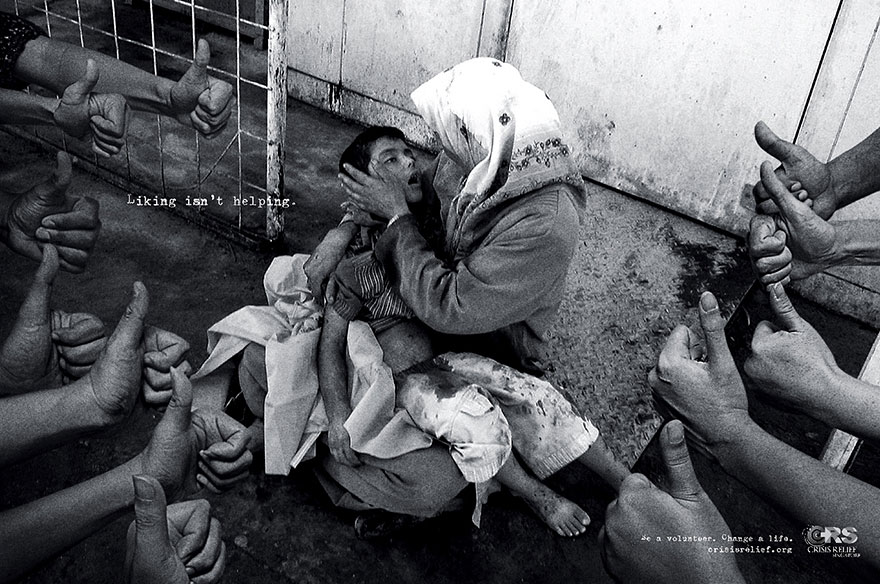
By: Publicis, Singapore
http://www.boredpanda.com/powerful-social-advertisements/
Although this is an ad, I think the photo alone is very powerful. I think that this photo could have the power to affect change because even without the writing on it, it is very moving having the thumbs up around and seeing visually what is happening in these places and the exact way we react to it, by giving it a "like". I think that this image is powerful enough to affect change because it so clearly highlights a problem so relevant to our society.
Light Metering

By: Unknown
https://www.pinterest.com/stineshjem/backlit/
I think that this image was metered to the left of the woman, because it has a nice neutral balance of light. To the right of her, I think it would have overexposed the woman. As well as if it was metered on the woman, she would be underexposed and if it was metered on the sun, she would be overexposed. We know that this image was not metered on the woman or else she would be black.If it were a front lit image, you would meter on the woman and there would be no glow around her head and no rays coming out of the sun.
Light, Shadow and Reflections
Light, Shadow and Reflections
SILHOUETTE

By Calder Miles
https://newhavennoir.wordpress.com/tag/new-haven-2/
BACK LIT NON SILHOUETTE

By Bethan Phillips
https://www.flickr.com/photos/beth19/4612316499/in/photostream/
REFLECTIONS

By Unknown
http://cdn.trendhunterstatic.com/thumbs/joanna-lemanska.jpeg

By Mik
https://www.smashingmagazine.com/2008/11/50-beautiful-examples-of-reflections-photography/

By Janusz Leszczynski
https://www.smashingmagazine.com/2008/11/50-beautiful-examples-of-reflections-photography/
SHADOWS
By Massi Miliano
https://www.smashingmagazine.com/2009/03/showcase-of-beautiful-shadow-photography/

By Alexey Bednij
http://www.demilked.com/shadow-photography-alexey-bednij/
https://www.smashingmagazine.com/2009/03/showcase-of-beautiful-shadow-photography/
By Alexey Bednij
http://www.demilked.com/shadow-photography-alexey-bednij/
Wednesday, January 27, 2016
Margaret Bourke-White

Margaret Bourke-White Fun Facts:
Bourke-White did the first cover of Life magazine. When Russia closed its borders, she managed to get in and photograph the rise of industry. She was aggressive and relentless and was in the right place at the right time, which led to great photographs.
The photo shown above was taken in Auschwitz during WWII. She took these photographs because it was a way for her to see what was happening without seeing it with her naked eye, because this was too terrible for her to see.
"Using the camera was almost a relief; it interposed a slight barrier between myself and the white horror in front of me." -Margaret Bourke White
The photo shown above was taken in Auschwitz during WWII. She took these photographs because it was a way for her to see what was happening without seeing it with her naked eye, because this was too terrible for her to see.
"Using the camera was almost a relief; it interposed a slight barrier between myself and the white horror in front of me." -Margaret Bourke White
https://iconicphotos.files.wordpress.com/2009/10/523.jpg?w=700&h=607
http://time.com/3638432/behind-the-picture-the-liberation-of-buchenwald-april-1945/
http://time.com/3638432/behind-the-picture-the-liberation-of-buchenwald-april-1945/
Sunday, January 24, 2016
Semester One Digital Portfolio
I really enjoyed photography this semester. It was much more challenging than I imagined it would be, and much more challenging than Photo 1-2. I think the thing that was hardest for me was that for each roll of film and each print, there are so many things that could go wrong. One of my rolls of film did not catch towards the beginning of the semester, which resulted in a blank roll which was very upsetting. After that, I got about 15 good prints in one day, and while I was printing, I wrote the aperture, time, and filter I used for each print on the back in pink sharpie. Not being able to use any of these prints really set me back time wise and used up a lot of paper. But through this I learned a valuable lesson and I will not repeat this mistake in the future. My favorite images are the first, seventh, and eighth images. I really like each one for a different reason- the first one for the composition, the seventh for the mood, and the eighth for the lighting and contrast. My least favorite is the pumpkin and the wheelbarrow one, because I think it is the weakest compositionally. In the future, I would love to explore lighting more because I find this element very interesting and fun to work with.
https://docs.google.com/presentation/d/1GOA08r-LhXJMNXHX5hBimVwnlCw2dPGcxGi5LyrwuG8/edit?usp=sharing
Motion
The two following types of motion are used by using a faster shutter speed, anywhere from 200 to 1500. This is done to freeze the motion. The third photo uses a slower shutter speed, such as 1 or 2, in order to capture the movement rather than freeze it.

By Ann Ray

Unknown

By Lisa Clarke
By Lisa Clarke
Subscribe to:
Comments (Atom)